TL;DR: Plant Royal Palms well clear of your septic drain field lines to limit root intrusion risk. The exact setback distance depends on your system’s layout, your soil, and local code, so have a landscape professional confirm it before anyone digs.
Choosing the right Royal Palm distance from septic field lines in Davie starts with knowing exactly where your system sits. Many larger lots in western Davie and nearby Southwest Ranches still run on septic rather than city sewer, and those properties are often where homeowners want a stately row of Royal Palms. A Royal Palm can reach 50 to 70 feet and stand for generations, so its placement is a long-term decision. Getting it right at the start protects the palm and one of the most expensive systems on your property.
Why Does Distance From the Drain Field Matter?
Palm roots grow toward the steady moisture and nutrients a drain field provides. If a palm is planted too close, that root growth can interfere with how the field absorbs and filters wastewater.
Royal Palms (Roystonea regia) form a dense mat of fibrous roots instead of one deep taproot. Those roots don’t thicken the way oak or ficus roots do, which is why palms are gentler on hardscape than many shade trees. They do spread wide near the surface, though, and that is the same zone where drain field pipes and gravel beds sit.
In Broward County, the water table runs high, and many drain fields are shallow or mounded. That puts roots and pipes closer together than they would be in drier parts of the state. Roots that work their way into distribution lines can clog perforations and slow absorption.
The first warning signs are usually soggy ground, odors, or slow drains inside the house. Fixing the problem can mean septic repairs, root removal, or losing a mature palm that took years to establish.
Septic clearance is only one part of good specimen palm placement. Spacing, sun exposure, sight lines from the pool, and irrigation all play a role, and our full tropical landscape design guide walks through each one.
How Do You Confirm the Safe Royal Palm Distance From a Septic Field in Davie?
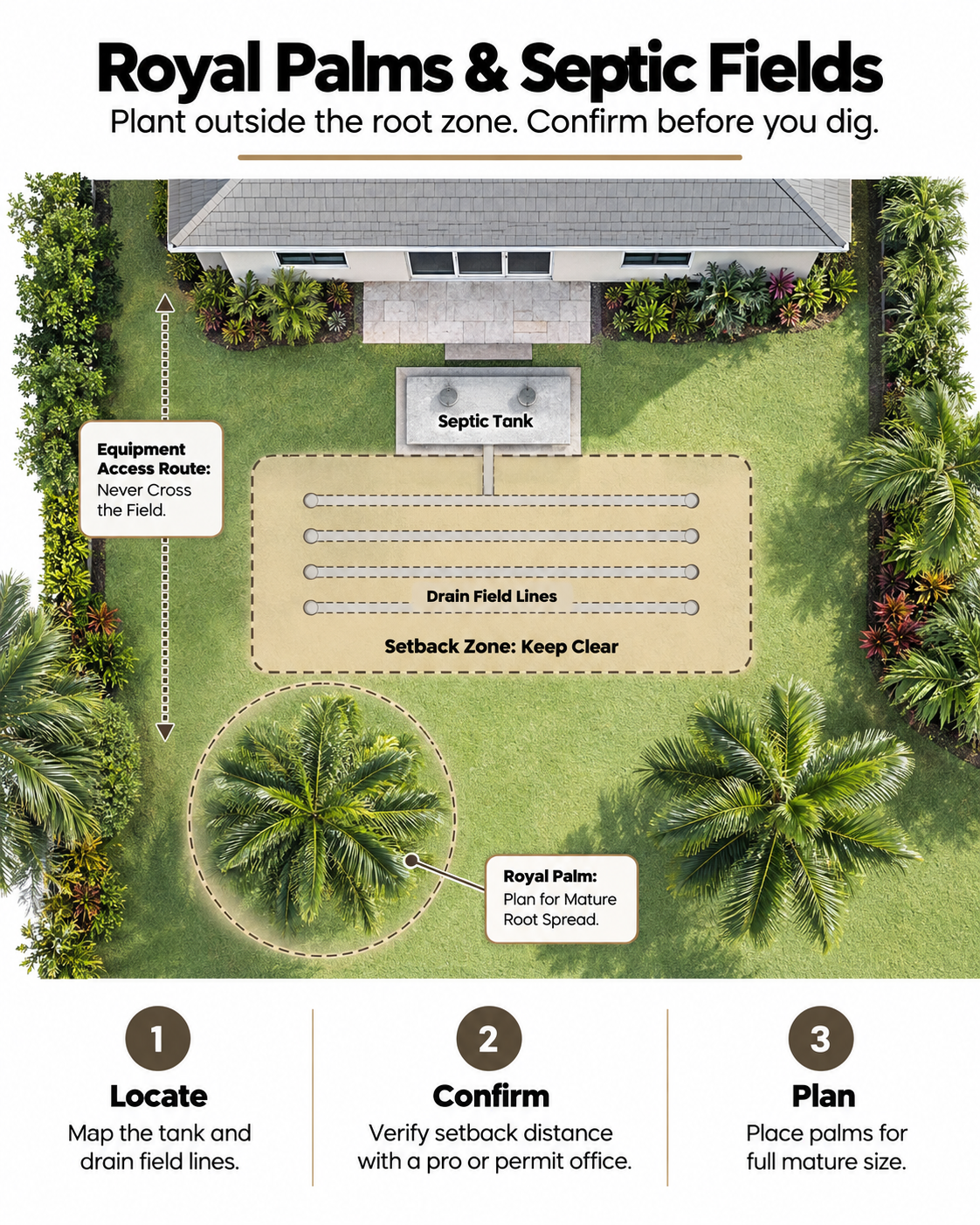
A landscape professional or the local permitting office can confirm the setback distance your property needs, based on your septic layout and current code. The process starts with mapping exactly where the tank and drain field lines run.
The Florida Department of Environmental Protection oversees septic permitting statewide. Permit records or as-built drawings often show where the tank and field were installed. If those records are missing or outdated, a licensed septic contractor can locate and mark the system for you.
Sunshine 811 marks public utilities before any digging, but it does not locate private septic lines, so don’t rely on it alone.
With the system mapped, a designer can set each Royal Palm septic setback based on the palm’s full mature root spread rather than its size on delivery day. Specimen tree planting distance also has to account for installation. A field-grown Royal Palm arrives on a truck and often goes in with a crane, and driving that equipment across a drain field can crush pipes and compact the soil above them.
Our palm and tree installation crew plans the access route along with the planting spot, so the field stays untouched from start to finish.
“Checking septic and utility placement before finalizing a landscape plan is a step that saves homeowners real money down the line,” says Matt Patella, who brings 11 years of landscape design and installation experience to The Time Is Now Design and Build.
Quick Questions
Do all palm species pose the same root intrusion risk to septic fields?
No. Root aggressiveness varies by species and by mature size. Royal Palms have a more contained, fibrous root system than many large shade trees, but their roots still reach toward moisture. Leaving an appropriate setback distance is still recommended, especially for a specimen palm you expect to reach full height.
What happens if a specimen tree is planted too close to a drain field?
Over time, roots can grow into the field’s moisture and interfere with drainage. That can lead to slow drains, wet spots, or odors in the yard. Resolving it may require costly septic repairs, root removal, or removing the tree entirely, so careful placement up front is the far better path.
What can go on top of a drain field?
Shallow-rooted turfgrass is the standard cover, because it holds the soil without sending deep roots into the lines. Most drain field landscaping rules call for keeping trees, large shrubs, patios, and heavy hardscape off the field. You should also avoid driving or parking over it.
Plan Your Royal Palms Around Your Septic System
Every palm we place starts with a mapped site plan, so your new specimen trees and your septic system can share the yard for decades. With 11 years of proven expertise and in-house craftsmanship from design through installation, our team handles placement, access, and planting with premium quality at every step.
We serve Davie, Weston, Southwest Ranches, Parkland, Coral Springs, Fort Lauderdale, and Boca Raton. When you’re ready, schedule your free landscape consultation and we’ll confirm the right Royal Palm distance from your septic field before a single shovel goes in the ground.