Most homeowners shopping for artificial turf in South Florida ask the same question: will it last? The answer depends almost entirely on whether the product was actually engineered for Florida's conditions — or just marketed as if it was. UV-resistant artificial turf built for full sun Florida exposure looks completely different under the hood than the turf being sold at big-box retailers, and that difference shows up clearly after a few summers in Broward or Palm Beach County.
South Florida sits in one of the highest UV exposure zones in the continental United States. The combination of intense sun, heat, and year-round outdoor use creates conditions that separate quality turf from disposable turf fast. We've installed synthetic grass across hundreds of properties from Parkland to Boca Raton, and we've seen what holds up — and what doesn't. This guide walks through exactly what to look for when choosing a UV-resistant turf product for a full-sun yard in South Florida.
TLDR — Key Takeaways
- Florida's UV is extreme — South Florida's UV index hits 10-11 regularly, nearly double the national average, which destroys low-quality turf faster than almost any other U.S. climate
- Fiber material is the #1 spec to check — polyethylene fibers with built-in UV stabilizers are the right choice; polypropylene belongs in backing materials, not blade fibers
- Infill determines comfort — standard crumb rubber traps heat; cooling infill systems (HeatBlock, coated silica sand) can drop surface temps by 30-50°F
- Warranty language tells the truth — a quality product warrants color retention explicitly for 15+ years; vague or short warranty = product not built for Florida sun
- Premium tier lasts 15-20 years; budget tier lasts 3-5 — the price gap at purchase rarely covers the cost of early replacement
- Installation decisions matter as much as product selection — shade mapping, drainage rate (minimum 30 in/hr), and infill matching to your yard's specific sun exposure all affect long-term performance
- Fading and brittleness are the failure modes to watch for — color shift toward olive/yellow and stiff, matting blades are the early signs a product wasn't built for Florida conditions
Why Florida's Sun Is Harder on Artificial Turf Than Almost Any Other Climate
Artificial turf manufacturers test their products. The problem is most of them test for average U.S. conditions, not South Florida conditions. There's a meaningful gap between the two.
UV Index Levels in South Florida vs. National Average
The UV index in Fort Lauderdale, Boca Raton, and surrounding South Florida communities regularly hits 10-11 on the scale, classified as extreme. The national average hovers around 5-6. That's not a minor difference — it means South Florida turf is absorbing roughly twice the UV radiation compared to a lawn in the Midwest or Pacific Northwest. Cumulative UV exposure is one of the primary drivers of fiber degradation and color fade in synthetic grass, which is why products that perform well in cooler climates can fail here within a few years.
How Heat and UV Exposure Degrades Low-Quality Turf
Most turf fibers are polymer-based, and polymers break down under sustained UV radiation. Without adequate UV stabilizer technology built into the fiber itself, the molecular bonds that give the turf its color, flexibility, and resilience begin to weaken. Heat accelerates this process. In South Florida, where surface temperatures can push past 150°F on a standard summer afternoon, that degradation happens faster than in any other U.S. climate.
Polypropylene fibers are particularly vulnerable. They're cheaper to manufacture and common in lower-tier products, but they're not suited for sustained full-sun exposure in hot climates. Polyethylene fibers with built-in UV stabilizers are a different category entirely — they're engineered to resist both the photochemical and thermal stress that South Florida delivers year-round.
What "Fading" and "Melting" Actually Look Like After 3-5 Years
Color fade in undertreated turf starts subtly — the rich green begins to shift toward olive or yellow, most noticeably in spots with the most direct sun exposure. By year four or five in a full-sun Florida yard, low-quality turf can look bleached and patchy. Fiber brittleness comes next. The blades lose their flexibility, become stiff, and start to mat down under foot traffic rather than recovering their upright position. In extreme cases, especially where turf has been installed near reflective surfaces like windows or white walls, localized heat concentration can cause surface distortion that looks like partial melting.
What to Look for in UV-Resistant Artificial Turf
Choosing the right product for a South Florida full-sun installation comes down to four things: fiber material, UV stabilizer quality, blade density and pile height, and infill selection. Each one affects how the turf performs in heat, how long it retains its color, and what the surface temperature feels like after an afternoon in direct sun.
UV Stabilizer Technology — What It Is and How to Verify It
UV stabilizers are additives integrated into the fiber during manufacturing. They work by absorbing or reflecting UV radiation before it can break down the polymer chains that give the fiber its structural integrity and color. The question to ask any supplier is whether the UV stabilizer is built into the fiber or applied as a coating. Coatings wear off. Built-in stabilizers don't.
When evaluating a product, look for explicit warranty coverage on color retention, not just fiber integrity. A manufacturer confident in their UV stabilization will warrant against significant fading for 15 years or more. If the warranty language is vague on color or caps out below 10 years, that tells you something about how the product will perform in South Florida sun.
Fiber Material Matters — Polyethylene vs. Polypropylene
For full-sun installations in South Florida, polyethylene is the correct fiber material. Polyethylene fibers are softer underfoot, more resistant to UV degradation, and better at maintaining their physical properties under repeated thermal stress. They're used in premium residential and commercial turf systems for exactly this reason.
Polypropylene has its uses — it's commonly used in backing materials and some thatch layers — but it should not be the primary blade fiber in a product going into a sunny South Florida yard. When comparing products, confirm the face fiber material. It's listed in the product spec sheet, and a reputable supplier should provide it without hesitation.
Pile Height and Blade Density for Heat Management
Blade density — measured in stitches per square inch — affects both the realism and the heat performance of artificial turf. Higher density products hold infill more effectively, which matters a great deal when that infill is doing thermal work. For residential South Florida applications, a pile height between 1.5 and 2 inches typically offers the best balance of natural appearance and heat management. Taller blades can trap more heat if infill is insufficient to fill the space between them.
Cooling Infill Systems That Reduce Surface Temperature
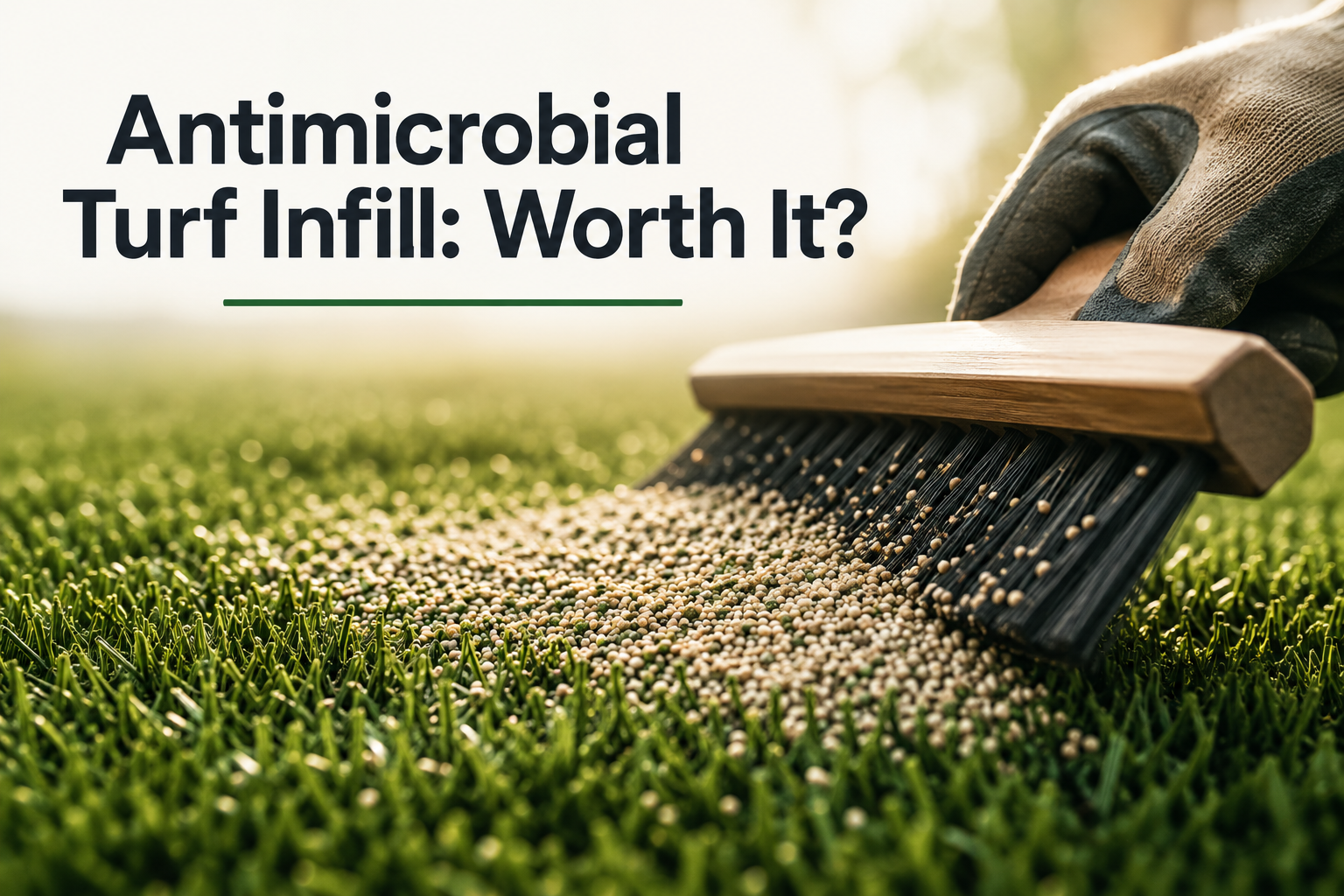
Infill selection is one of the most underestimated decisions in a turf installation, particularly in South Florida. Standard crumb rubber infill absorbs and retains heat, which is exactly what you don't want in a full-sun yard here. Cooling infill alternatives — including coated silica sand, acrylic-coated sand products, and HeatBlock technology systems — are engineered to reflect solar radiation rather than absorb it.
The difference is substantial. Premium cooling infill systems can reduce surface temperature by 30-50°F compared to standard infill in the same sun conditions. For a backyard where children play barefoot, or where the turf borders a pool deck, that temperature difference determines whether the space is actually usable on a South Florida afternoon.
The Best Artificial Turf Products for Full Sun in South Florida (2026)
Not all premium-priced turf is built equally for Florida conditions. The products worth considering for a full-sun South Florida installation share a common profile: polyethylene face fibers, manufacturer-verified UV stabilization, 15-year minimum color warranties, and proven performance data in hot climates.
Premium Tier — Products Built for Florida Conditions
At The Time Is Now Design & Build, we specify products that we've vetted specifically for South Florida's climate — not products that simply claim to be UV-resistant. The brands we work with in premium residential applications include SYNLawn, ForeverLawn, and FieldTurf residential lines. Each offers polyethylene fiber construction, documented UV stabilizer technology, and warranty coverage that holds up in writing.
We match the specific product to the specific yard. A shaded courtyard in a Weston townhome has different requirements than an open backyard in Parkland with western exposure and no tree cover. South Florida's sun angles and neighborhood microclimates vary enough that a one-size-fits-all product recommendation rarely produces the best long-term result.
What Warranties to Look For and What They Actually Cover
Read the warranty before committing to any turf product. Specifically, look for three things: whether color retention is explicitly covered (not just fiber integrity), the minimum warranty period (15 years is the benchmark for premium products), and whether the warranty transfers with the property sale.
Warranty exclusions matter too. Some manufacturers will exclude UV damage if the turf is installed within a certain distance of reflective surfaces, or void the warranty if non-approved infill was used. Understanding these details before installation prevents surprises later. We review warranty terms with every client before finalizing a product selection — it's a non-negotiable part of how we approach each project.
Artificial Turf Installation Considerations for Full Sun Yards in South Florida
Even the right product can underperform if the installation process doesn't account for South Florida's specific conditions. Site preparation, drainage design, orientation, and infill selection are all installation decisions — and they all affect how the turf performs in full sun over time.
Orientation and Shade Mapping Before Installation
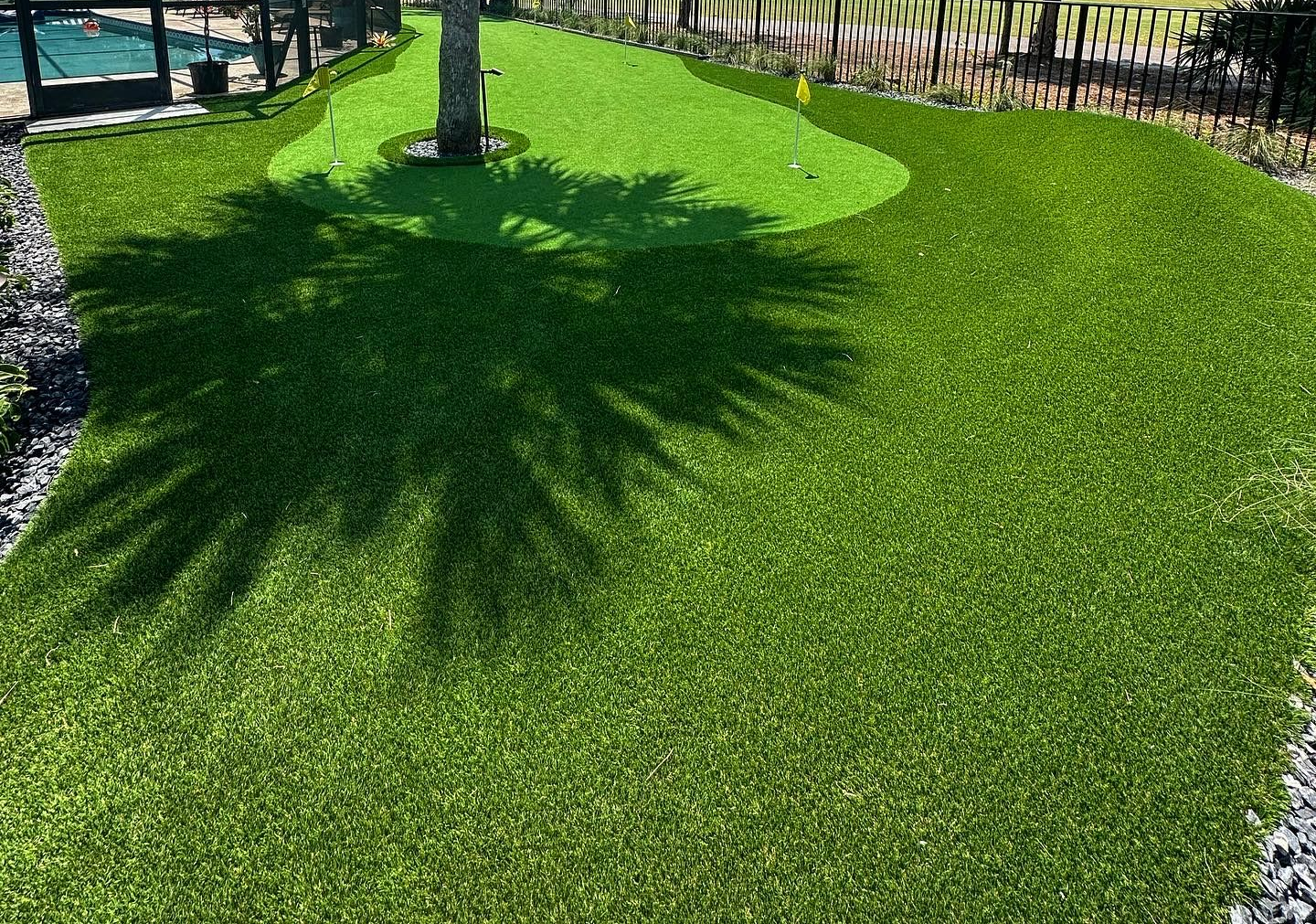
Before we lay a single piece of turf, we assess the sun exposure patterns of the specific yard. In South Florida, western and southwestern exposures receive the most intense afternoon sun, which is when UV index and surface temperatures peak. Knowing which sections of the yard absorb the most sustained heat lets us make smarter decisions about product selection, seam placement, and infill density in those zones.
We also check for nearby reflective surfaces — windows, white walls, pool coping, screen enclosures — that can concentrate heat onto specific turf areas. In some cases, this mapping changes the product recommendation entirely, or leads us to specify a heat-resistant backing material for targeted sections.
Drainage Rate Requirements for Florida's Rainfall
South Florida averages over 60 inches of rain per year, with intense summer storm systems that can drop several inches in under an hour. Any artificial turf installation here needs a drainage rate that keeps pace. The minimum we specify is 30 inches per hour — a rate that handles Florida's heaviest rain events without pooling or odor buildup.
Drainage performance also affects how quickly the turf surface cools after rain, which matters for heat management. A well-draining installation dries faster and recovers its normal surface temperature more quickly than a system with inadequate drainage. The sub-base design is just as important as the turf product itself in achieving this.
Infill Selection for Heat Reduction
For full-sun South Florida installations, we default to cooling infill systems rather than standard crumb rubber. The specific product depends on the application — pet-friendly antimicrobial options for households with dogs, acrylic-coated silica sand for pool-adjacent installations, and HeatBlock technology variants for yards with the highest direct sun exposure. The infill decision gets made after the site assessment, not before.
How Long Should UV-Resistant Artificial Turf Last in Florida?
Lifespan varies significantly by product tier, installation quality, and how well the yard is maintained. Here's how to set realistic expectations based on what we see in the field across Broward and Palm Beach Counties.
Realistic Lifespan Expectations by Product Tier
Premium UV-stabilized turf, professionally installed with a quality sub-base and cooling infill: 15-20 years is a realistic lifespan expectation in South Florida, consistent with manufacturer warranty coverage. The turf will show some natural matting and compression in high-traffic areas over time, but color and fiber integrity hold up well with this product tier.
Mid-tier products with standard UV treatment: typically 8-12 years in South Florida full-sun conditions. Color retention begins to visibly decline after year six or seven in direct exposure. Fiber brittleness becomes noticeable around years eight to ten.
Entry-level or unverified products: our experience watching these installations in South Florida is that significant degradation shows up within 3-5 years in full sun. The money saved at purchase rarely compensates for the cost of replacement.
How Maintenance Affects Longevity in Full Sun Installations
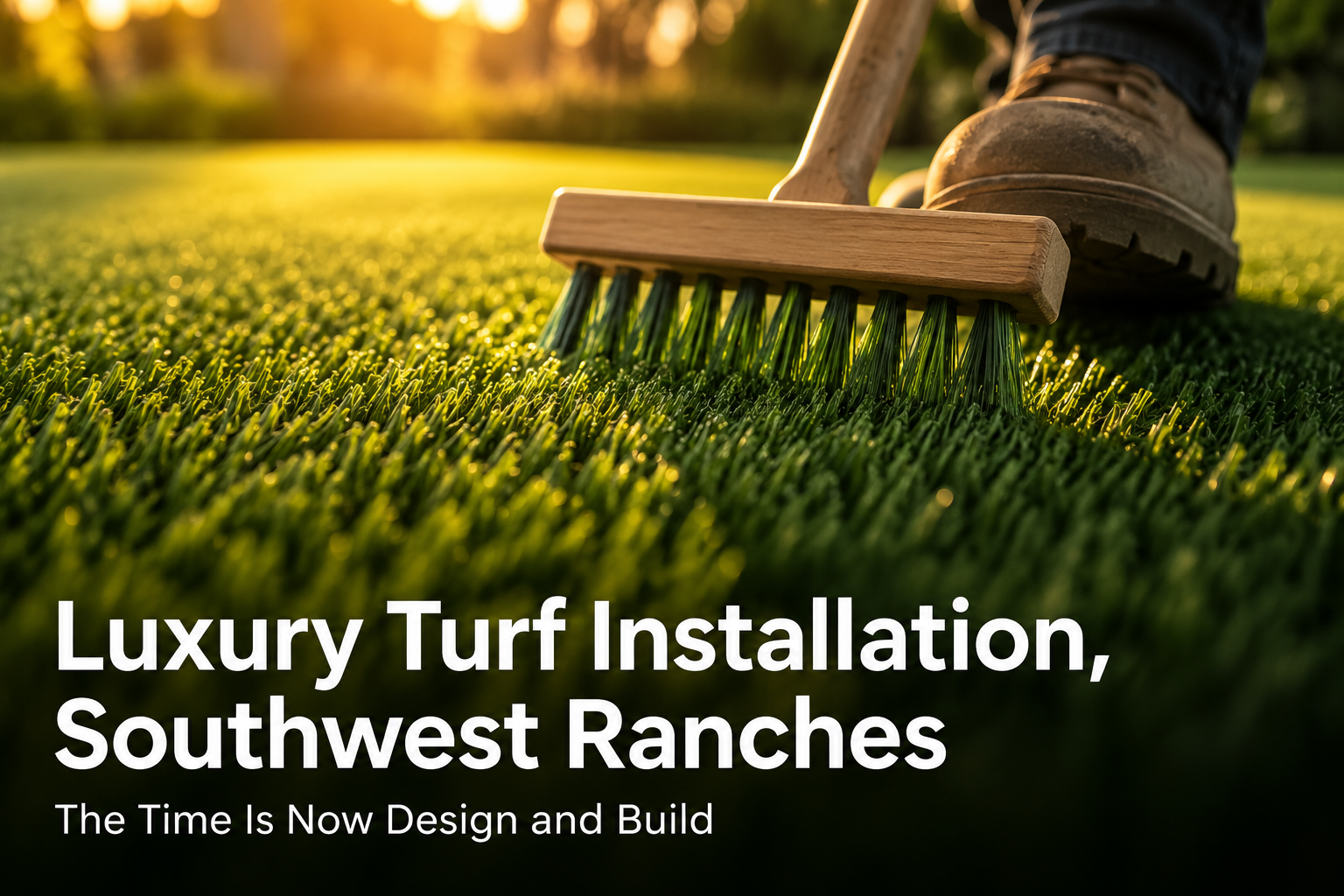
Premium turf in South Florida requires very little maintenance, but the maintenance it does require matters for longevity. Regular rinsing clears salt air residue and organic debris that can break down backing materials over time. Periodic grooming with a stiff-bristle broom keeps blades upright in high-traffic areas and prevents matting. Checking infill levels annually and topping up as needed keeps the thermal and cushioning performance consistent.
Avoiding pressure washing with high heat settings, keeping reflective surfaces from concentrating sun onto specific turf zones, and clearing debris promptly after storms all contribute meaningfully to whether a South Florida installation reaches the high end of its lifespan range.
"South Florida's sun is relentless, and it exposes every shortcut in a turf installation. We've seen properties where the homeowner spent good money on a product that looked beautiful at installation and was washed out and brittle within four years because the UV stabilization wasn't adequate for this climate. We only specify products we've tested and stood behind in Florida conditions — and we match the infill system to the specific sun exposure of each installation. The difference in longevity is not marginal. It's years." — The Time Is Now Design & Build
Get a Free Turf Consultation for Your Property
The biggest mistake homeowners make with artificial turf in South Florida is choosing a product based on price or appearance alone, without understanding how it was engineered. A lawn that fades, overheats, or needs replacement in five years isn't a savings — it's a significant cost. The right product, matched to your specific yard's sun exposure and installed correctly, should still look sharp 15 years from now.
At The Time Is Now Design & Build, we assess your property before we recommend anything. We look at sun orientation, drainage needs, existing landscaping, and your specific goals — then we specify the turf and infill system that makes sense for your yard, not just the next one.
We carry premium UV-resistant turf lines built for South Florida conditions, and every installation is completed by our fully in-house team — no subcontractors, no handoffs, no surprises. We've been doing this across Broward and Palm Beach Counties since 2015, and we stand behind the products we specify and the work we install.
Call or text us at 954-482-1221, or schedule your free consultation online. Bring your questions about products, warranties, and what to expect — we'll give you straight answers.
Get Your Free Turf ConsultationChoosing UV-resistant artificial turf for a full-sun Florida yard is a decision that pays off for years — or costs you years — depending on how it's made. Broward and Palm Beach County homeowners who invest in the right product and a quality installation reliably get the green, low-maintenance yard they were after. The Time Is Now Design & Build has the experience in South Florida's specific conditions to guide that selection and back it up with craftsmanship that lasts.
Frequently Asked Questions
What is the best artificial turf for Florida's full sun?
The best artificial turf for Florida's full sun uses polyethylene fibers with built-in UV stabilizers, cooling infill systems like HeatBlock or silica sand, and a drainage rate of at least 30 inches per hour. Premium brands engineered for hot climates — including SYNLawn, ForeverLawn, and FieldTurf residential lines — are among the products The Time Is Now Design & Build specifies for South Florida full-sun installations.
Does artificial turf get too hot in Florida?
Standard artificial turf can reach surface temperatures of 150-180°F in direct South Florida sun. Premium turf systems with cooling infill technology and lighter blade colors can reduce that surface temperature by 30-50°F compared to untreated products. Proper infill selection is the single biggest factor in making South Florida turf comfortable for barefoot use during the afternoon hours.
How long does artificial turf last in Florida's heat?
High-quality UV-stabilized artificial turf professionally installed in South Florida will typically last 15-20 years. Lower-quality products without proper UV treatment may show significant color fade and fiber degradation within 5-7 years of full-sun exposure. Product tier and installation quality are the two variables that matter most in determining actual lifespan in Florida conditions.
Will artificial turf fade in Florida?
Lower-quality turf products will fade noticeably within a few years of full Florida sun exposure. Premium turf manufactured with UV stabilizers and high-grade polyethylene fibers is engineered to maintain color integrity for 15 or more years. Always verify UV fade warranty coverage before selecting a product — if a manufacturer won't warrant against color fade in writing, that's a meaningful signal about the product's performance expectations.
Is artificial turf worth it in South Florida?
For South Florida homeowners, premium artificial turf eliminates irrigation costs, removes the need for fertilizer and pesticide treatments, and maintains a manicured appearance year-round. The long-term return against ongoing lawn maintenance costs is strongly positive for most residential applications. The key is investing in a product and installation quality that reaches the full 15-20 year lifespan — an installation that fails at year five changes that math entirely.