TL;DR
- The top fast-growing privacy trees for South Florida backyards are Small-Leaf Clusia, Podocarpus, and Green Buttonwood for hedging and screening.
- For specimen installations, Sylvester, Royal, and Areca Palms are the most sought-after choices on luxury Broward County properties.
- Species selection depends on your HOA guidelines, soil conditions, proximity to pool or hardscape, and how quickly you need privacy coverage.
South Florida homeowners in Davie, Weston, and Parkland invest heavily in their outdoor environments. One question comes up constantly before any landscape project moves forward: which trees actually perform in South Florida's heat, salt air, and humidity without becoming a maintenance headache or an HOA violation? The answer depends on your goals. Privacy hedges and specimen palms solve very different problems. This guide walks through both, with specific species guidance, realistic cost ranges, and the installation details that separate a successful planting from one you'll regret in two years.
What Privacy Trees Grow Best in South Florida's Climate?
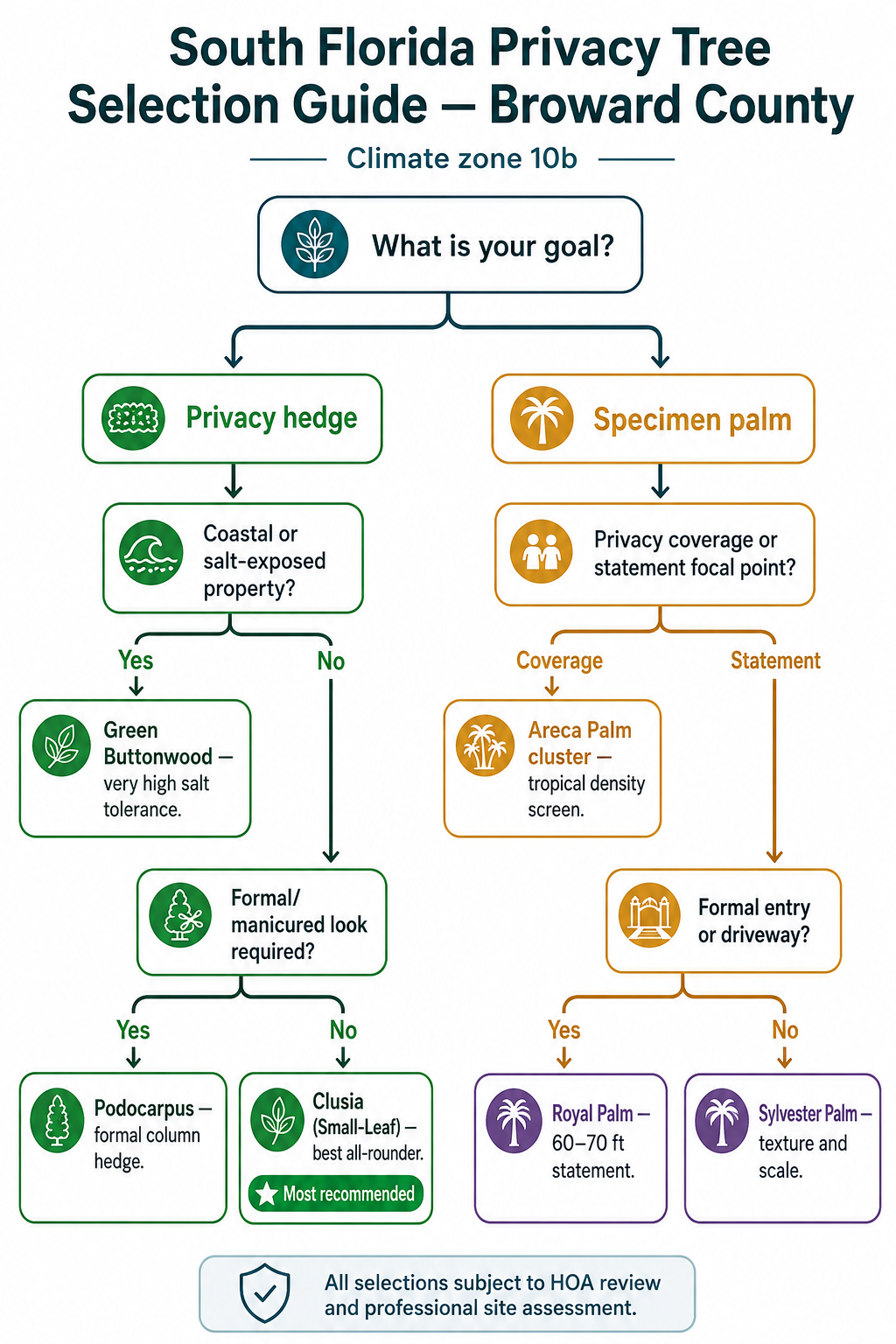
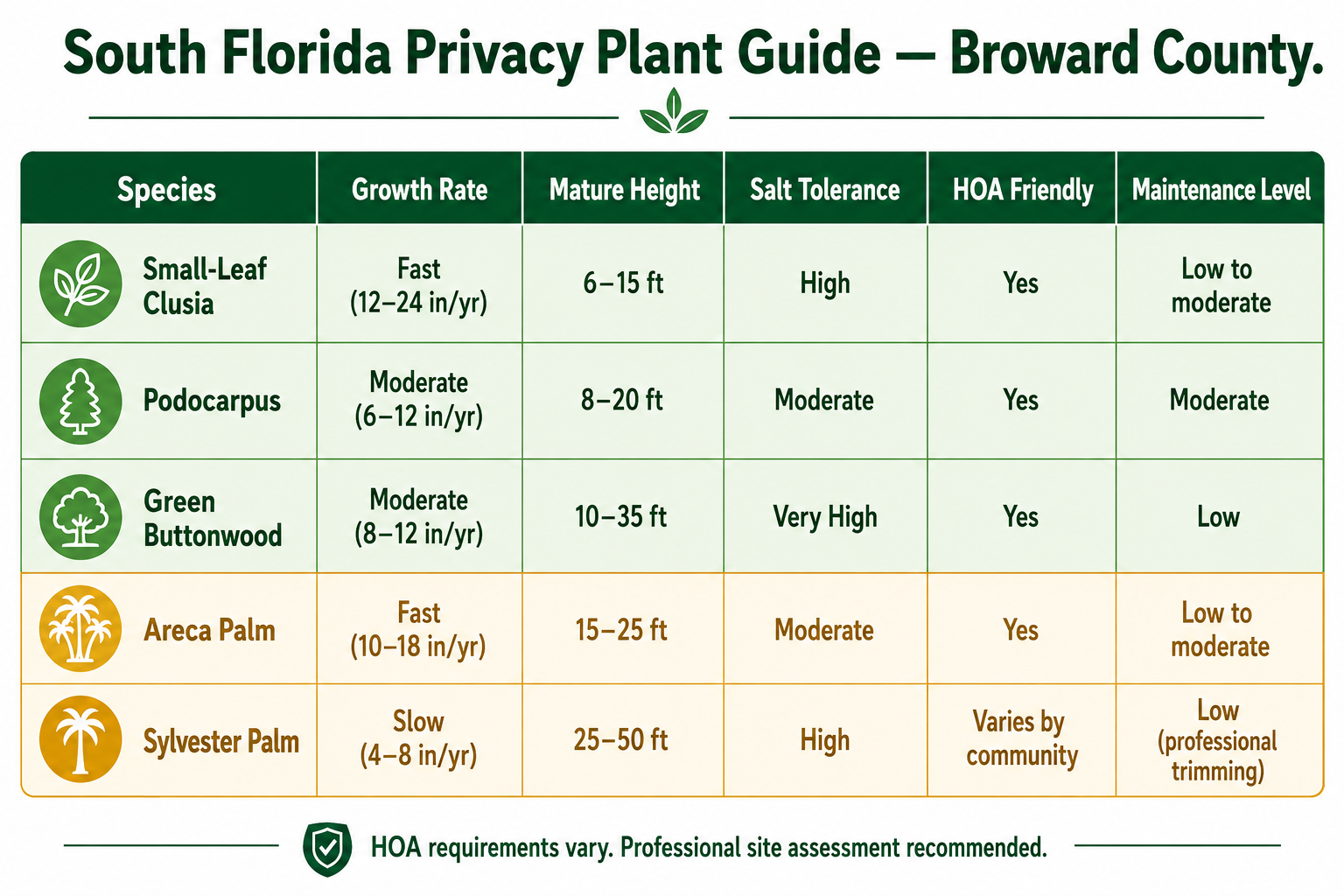
South Florida's climate zone 10b supports a wide range of fast-growing privacy species, but the most reliable performers for Broward County homeowners are Small-Leaf Clusia for dense screening, Podocarpus for formal hedging, and Green Buttonwood for salt-exposed properties near the coast.
Each of these species has earned its reputation through years of local performance, not just nursery appeal. Understanding what makes them work in South Florida's specific conditions is what separates a long-lasting planting from one that struggles within the first growing season.
Clusia: The Workhorse of South Florida Privacy Hedges
Clusia guttifera (Small-Leaf Clusia) grows 12 to 24 inches per year under proper care and reaches a mature height of 6 to 15 feet when maintained as a hedge. It produces a dense, broad-leafed wall that blocks sightlines almost completely within two to three growing seasons. It tolerates salt air, periods of drought, and the humidity swings that come with South Florida summers better than most alternatives.
For homeowners in Fort Lauderdale and Broward County who want screening without constant maintenance, Clusia is usually the first recommendation. If you are still deciding between Clusia and Podocarpus, our detailed breakdown of
Clusia vs Podocarpus for Fort Lauderdale privacy hedges covers growth rates, trimming behavior, and salt tolerance side by side.
Podocarpus: Formal Screening with a Slower Payoff
Podocarpus macrophyllus grows more slowly than Clusia at roughly 6 to 12 inches per year, but it rewards patience with a more refined, columnar appearance that suits formal landscape designs. It trims cleanly into precise shapes and maintains a tighter silhouette than Clusia, which makes it the preferred species when a manicured, architectural look is the goal.
One important consideration for coastal properties: Podocarpus has moderate salt tolerance. For homes very close to the ocean or in areas with high salt spray exposure, Clusia or Green Buttonwood will outperform it. Inland communities in Weston, Southwest Ranches, and Parkland are ideal environments for Podocarpus.
Green Buttonwood and Other Salt-Tolerant Alternatives
Green Buttonwood (Conocarpus erectus) is the go-to choice for properties with significant coastal exposure. It tolerates salt air at a level that few other hedging species can match and can be maintained as either a formal hedge or allowed to grow into a mid-size tree form reaching 10 to 35 feet.
Beyond its coastal suitability, Green Buttonwood is a Florida-friendly landscaping species that requires minimal supplemental irrigation once established. For properties in Lighthouse Point, Deerfield Beach, or coastal Fort Lauderdale, it is frequently the strongest long-term performer.
What Are the Best Specimen Palms for Broward County Properties?
Sylvester Palms, Royal Palms, and Medjool Date Palms are the most sought-after specimen palms for luxury South Florida properties. Each requires professional installation equipment due to size and root ball weight, and correct staking and irrigation setup is critical to establishment.
A specimen palm is not just a plant. It is a structural element in your landscape, often serving as a focal point that defines the entire property's character. Choosing the right species requires matching the palm's mature scale to your property's size, architecture, and HOA guidelines.
Sylvester Palm: Texture, Scale, and Root Considerations
The Sylvester Palm (Phoenix sylvestris) is one of the most visually distinctive specimen palms available in South Florida. Its diamond-patterned trunk, feathery fronds, and commanding presence make it a standout choice for estate properties in Weston, Parkland, and Southwest Ranches. Mature specimens can reach 25 to 50 feet in height.
Root spread is a common concern from homeowners who want a Sylvester near pool equipment or a deck. The root system is fibrous and lateral, not deep or invasive. When planted at 8 to 10 feet of clearance from pool coping or hardscape edges, structural damage is not a realistic concern. (More on this in the section below specifically on root behavior.)
Royal Palm: The Statement Tree for Formal Landscapes
The Royal Palm (Roystonea regia) is the classic South Florida statement tree. Its smooth gray trunk, clean green crownshaft, and formal symmetry make it a natural choice for property entries, long driveways, and symmetrical landscape designs. Royal Palms grow to 60 to 70 feet at maturity, so they belong on properties where vertical scale is intentional, not an afterthought.
Installation of a Royal Palm requires crane equipment regardless of the specimen's current size, and proper staking during the establishment period is non-negotiable. An improperly staked Royal Palm in South Florida's wind corridor is a significant risk.
Areca Palm Clusters: Privacy and Tropical Density
Areca Palms (Dypsis lutescens) serve a dual purpose: they function as both a privacy screen and a specimen planting. Installed in clusters of three to five palms, they create a lush, multi-stem tropical effect that grows to 15 to 25 feet. They establish faster than most large-canopy palms and begin providing meaningful privacy coverage within 12 to 18 months of a professional installation.
They are well-suited to properties where a Clusia hedge is not preferred and where the homeowner wants a more tropical, open-canopy look rather than a solid wall of foliage.
How Much Does Specimen Palm and Privacy Tree Installation Cost in South Florida?
Specimen palm installation in Broward County typically runs $800 to $3,500 or more per palm, depending on species, trunk height, and access requirements. Privacy hedge installation runs $25 to $60 per linear foot installed, depending on plant size and species. Crane rental for large specimen palms adds cost that should be clearly itemized in any estimate.
These ranges reflect the full scope of a professional install: the plant material, equipment, site preparation, staking, and initial irrigation setup. What they do not include are any permits required by your municipality or HOA-mandated landscaping reviews, which vary by community.
What Drives the Cost of Specimen Tree Installation
The single biggest cost variable for specimen palms is trunk height. A Sylvester Palm with 4 to 6 feet of clear trunk is priced very differently than one with 10 to 12 feet of established trunk. Larger specimens require crane or boom truck equipment for safe placement, and the labor associated with positioning a multi-hundred-pound root ball is significant.
Access to the planting site also affects cost. Properties in gated communities or with narrow side gates may require specialized equipment or additional crew time to navigate the site safely.
What a Professional Installation Includes vs. a Drop-and-Go Service
A professional installation at the level The Time Is Now Design & Build delivers includes site assessment, soil amendment at the planting hole, proper root ball placement, structural staking calibrated to the palm's weight and wind exposure, and irrigation setup for the establishment period.
A "drop-and-go" service, common with lower-cost landscaping companies, delivers the plant to the site and places it in a hole without the preparation work. The difference shows up within 90 days. Palms placed in unamended South Florida soil without proper drainage and without establishment irrigation fail at a much higher rate, and replacing a failed $2,500 specimen is an avoidable expense. Our guide to combining privacy landscaping with artificial turf for a complete backyard walks through how the two projects work together and what to sequence first.
Privacy tree and specimen palm installation in Broward County by a crew that handles every element in-house is the factor that separates a thriving landscape from a costly mistake.
Do HOA Rules in Broward County Restrict Which Trees You Can Plant?
Many HOA communities in Weston, Parkland, and Southwest Ranches have specific landscaping guidelines that restrict tree species, maximum height, and placement near property lines or sidewalks. A professional installer familiar with local HOA requirements can review your community's guidelines before plant selection begins.
This step gets skipped more often than it should. Homeowners who plant first and ask questions later sometimes find themselves removing trees at their own expense, which is a frustrating outcome on a project meant to improve their property.
Common HOA Restrictions in Weston and Parkland Communities
In Weston, HOA guidelines frequently regulate hedge height along street-facing property lines, species approved for front-of-home planting, and placement distances from sidewalks and utilities. Parkland communities often have similar restrictions, with some specifying approved species lists that a homeowner must select from rather than choosing freely.
Southwest Ranches properties, while generally on larger lots with more flexibility, can still carry deed restrictions that govern tree species and placement.
How to Get HOA Approval Before Installation
Most HOAs require a landscape plan submission with a plant list and a site diagram showing placement distances from property lines, structures, and utilities. The review period varies by community, typically running two to six weeks. Starting this process before purchasing plant material is critical. Plant material cannot simply be held at a nursery indefinitely, and delays caused by an HOA review after materials are purchased create unnecessary pressure.
A professional landscaping contractor who has worked across Broward County communities will know which HOAs require formal submissions, which require only neighbor notification, and which have informal review processes.
Will a Sylvester Palm or Large Specimen Tree Damage My Pool Deck or Foundation?
Sylvester Palms have a fibrous, non-invasive root system that spreads laterally but does not typically penetrate concrete pool decks or foundations when planted at proper clearance distances of 8 to 10 feet from pool coping or hardscape edges. Unlike ficus or oak species, palms do not produce the aggressive root growth that causes structural damage.
This is one of the most common questions homeowners ask before committing to a Sylvester Palm, and the concern is understandable. Large trees and pool decks are expensive, and the idea of one damaging the other is a real hesitation. The science of palm root behavior is reassuring here. Palm roots are fine and fibrous, not woody and expansive. They grow laterally in the top 12 to 18 inches of soil and do not have the root pressure that causes the deck lifting or pipe infiltration associated with species like ficus.
The 8-to-10-foot clearance recommendation is not arbitrary. It accounts for the lateral root spread of a mature Sylvester in South Florida's sandy soil profile and provides an adequate buffer for pool equipment, coping, and paver systems. Plantings that fall inside that clearance on particularly large specimens may warrant a professional evaluation before the tree is placed.
For homeowners curious about
whether Sylvester Palm roots damage pool decks, a dedicated guide covers this topic in more detail.
How Is a Large Specimen Palm Actually Installed?
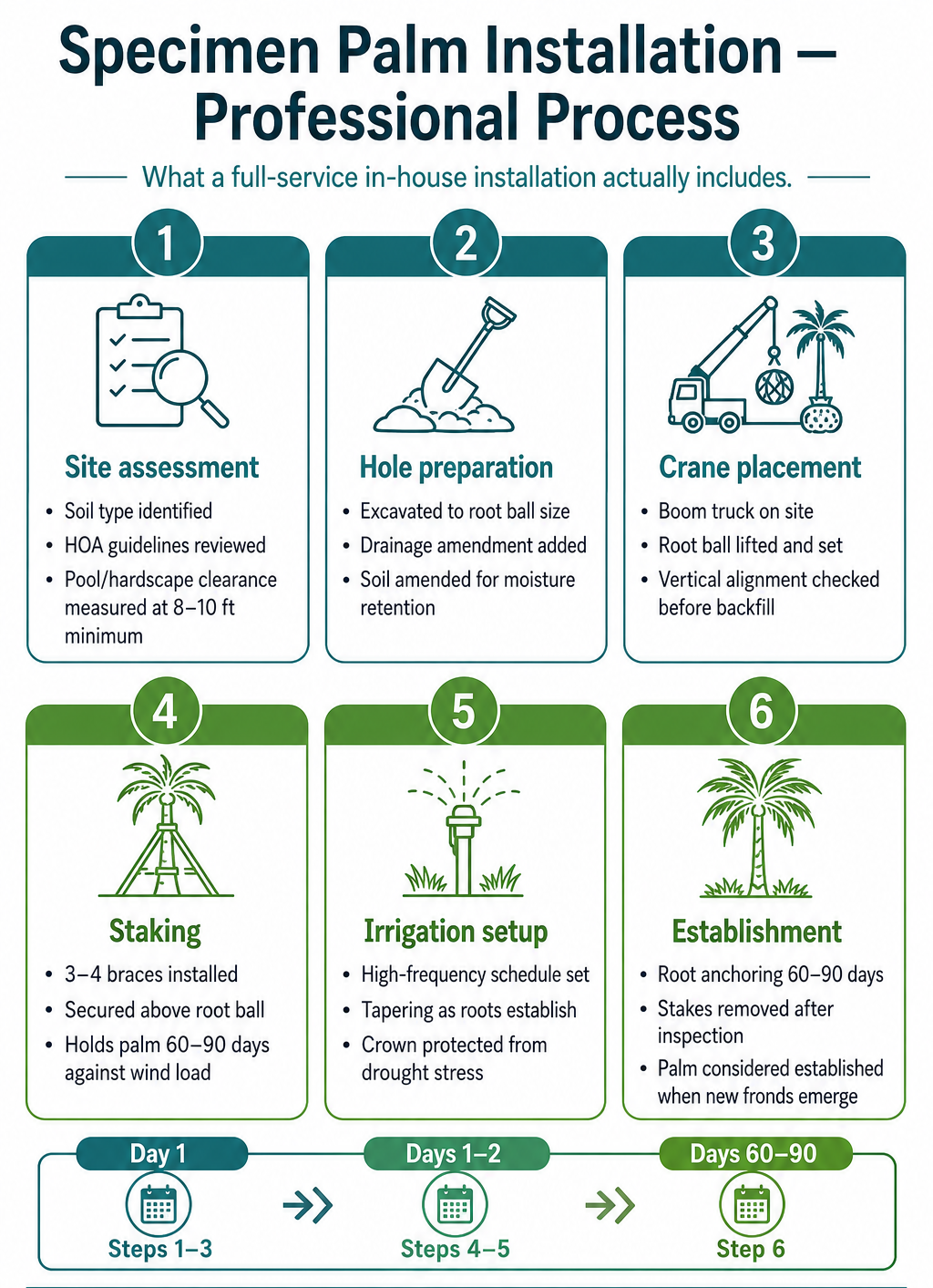
Large specimen palm installation requires a crane or boom truck to lift and position the root ball, a prepared planting hole with proper drainage amendment, installation staking for wind stabilization during the establishment period, and a calibrated irrigation setup. This is not a DIY or small-truck operation.
The process begins well before the palm arrives at the property. A proper planting hole is excavated to a depth and width that accommodates the root ball with room for soil amendment. South Florida's native soil varies from sandy loam to marl, and the amendment approach differs based on what is present at the site.
When the palm arrives, a crane positions it precisely into the prepared hole. This step requires coordination between the crane operator and the installation crew to achieve the correct planting depth and vertical alignment. An improperly angled palm is expensive to correct after the soil settles.
Staking follows immediately. Three to four braces secured to the trunk above the root ball hold the palm stable during the 60 to 90 day establishment window when the root system is not yet anchored to the surrounding soil. South Florida's wind exposure during this period is not forgiving to an unstabilized specimen.
Irrigation is set to run at a higher frequency during establishment, tapering off as the root system extends into the surrounding soil. A palm that goes dry during this window can suffer crown damage that takes years to recover from, or does not recover at all.
Frequently Asked Questions About Privacy Trees and Specimen Palms in South Florida
What are the best fast-growing privacy trees for South Florida?
The best fast-growing privacy trees for South Florida are Small-Leaf Clusia for dense, low-maintenance screening, Podocarpus for formal hedging, and Green Buttonwood for salt-exposed coastal properties. For properties with space, Areca Palm clusters provide rapid tropical privacy with a natural look. Selection depends on your site conditions, proximity to the coast, and HOA guidelines.
Are Clusia hedges better than Podocarpus for privacy in Fort Lauderdale?
Clusia grows faster and handles South Florida's salt air and humidity better than Podocarpus, making it the more popular choice in Fort Lauderdale and Broward County. Podocarpus is preferred when the goal is a more formal, manicured appearance. It trims into precise shapes better than Clusia and suits interior communities where salt tolerance is less of a factor.
How much does specimen palm installation cost in Boca Raton?
Specimen palm installation in Boca Raton and South Palm Beach County typically runs $800 to $3,500 or more per palm, depending on species, trunk height, and whether crane equipment is required. Large Sylvester or Royal Palms with significant trunk height sit at the higher end of that range due to equipment and labor requirements. A detailed estimate should itemize plant material, equipment, soil amendment, staking, and irrigation separately.
Will a Sylvester Palm damage my pool deck or foundation?
Sylvester Palms have a fibrous, non-invasive root system and do not typically cause damage to pool decks or foundations when planted at the recommended clearance of 8 to 10 feet from pool coping or structures. Unlike aggressive species such as ficus, palms are generally considered safe near hardscape when correctly sited and planted at proper clearance distances.
Do HOA rules in Weston restrict what trees I can plant?
Many HOA communities in Weston, Parkland, and Southwest Ranches have landscaping guidelines that regulate species selection, tree height, and placement near property lines. Requirements vary significantly by community. A professional landscaping contractor familiar with local HOA standards can review your community's guidelines before plants are selected, preventing the cost of removal and replanting.
Matt Patella's Perspective on Privacy Tree Selection in Broward County
"The number one mistake I see with privacy tree installs in Broward County is choosing a species based on what looks good at the nursery, without accounting for your soil, your HOA, or how close you're planting to your pool equipment or deck. Clusia is our most recommended species for Broward. It's fast, dense, and handles our salt air and humidity better than almost anything else. But if your HOA has height restrictions or you're within eight feet of pool coping, you need that conversation before you plant, not after."
— Matt Patella, The Time Is Now Design & Build, 11 years serving South Florida homeowners
Ready to Plan Your Privacy Landscape? Here's How We Start.
South Florida's planting season runs from fall through early spring, and that timing matters. Trees and palms installed during these months establish root systems before summer heat arrives, meaning less intensive irrigation management and a faster path to the privacy coverage you're looking for. Summer installs are possible, but they require more hands-on irrigation during the establishment period.
At The Time Is Now Design & Build, every project starts with a free on-site consultation. That visit covers species selection matched to your soil and site, HOA guideline review before any plant material is ordered, and a detailed estimate with every line item clearly explained. No vague quotes, no surprises after the crane shows up.
Our in-house installation team handles every phase: site prep, plant delivery, crane work for large specimens, staking, and irrigation setup. We serve homeowners across Davie, Weston, Parkland, Southwest Ranches, Fort Lauderdale, Boca Raton, and the broader Broward and South Palm Beach County area.
Schedule your free landscape consultation and get a plan built around your property, your HOA, and the results you actually want.
Licensed, insured, and locally rooted for 11 years. This is what in-house craftsmanship looks like.