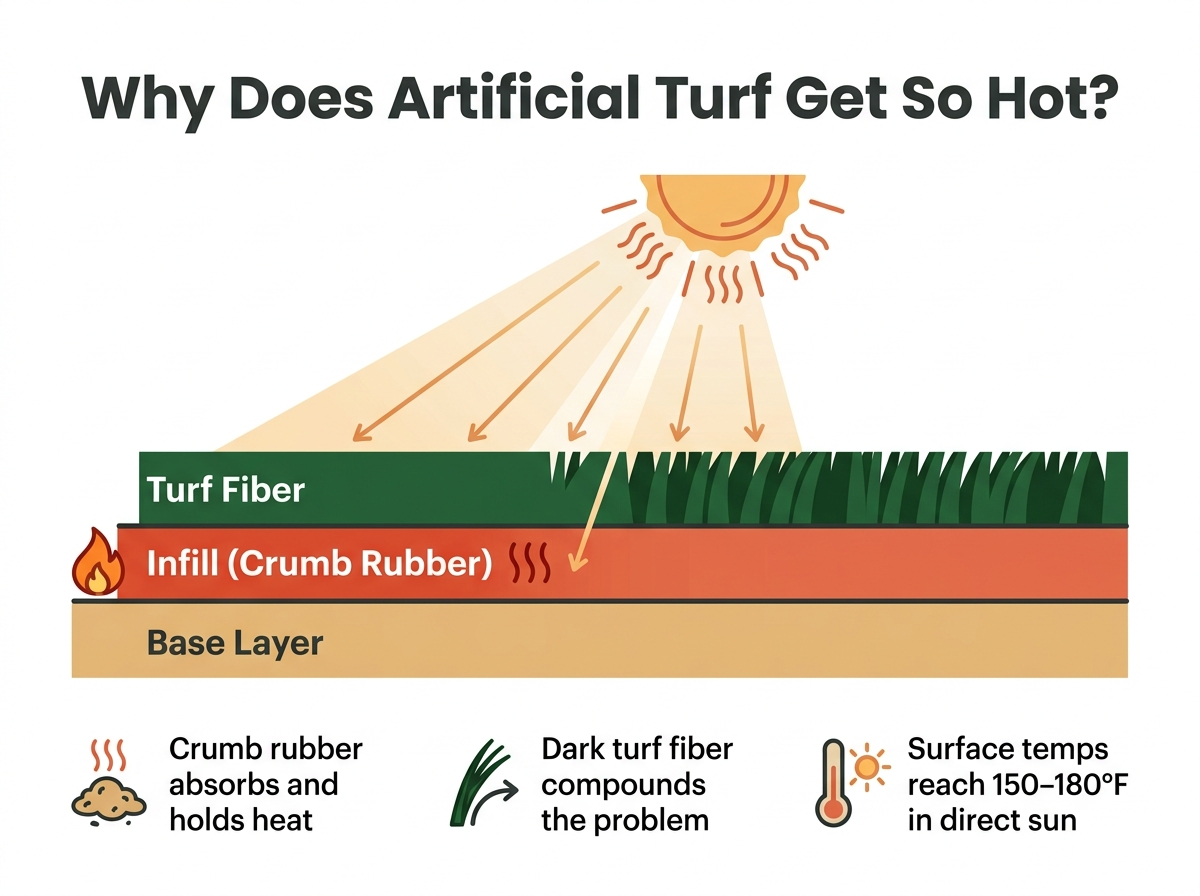
TL;DR: Artificial turf in Florida can reach surface temperatures of 150–180°F in direct sun, mostly because of crumb rubber infill and dark-colored turf fiber. Cork or silica sand infill, a lighter-colored product, and added shade are the most effective fixes.
A backyard too hot to walk across barefoot isn't doing anyone any good, no matter how green it looks. This is one of the most common complaints we hear from homeowners across Davie, Weston, and the rest of Broward County who installed turf elsewhere and now avoid their own yard between 11 AM and 5 PM. Artificial turf heat in Florida is real, but it's also solvable. The infill and product choices made at installation are almost always the reason one yard stays usable all afternoon while another turns into a frying pan.
Why Does Artificial Turf Get So Hot in Florida?
The primary culprit is crumb rubber infill, the dark, recycled rubber granules used as a base layer in many installations. Crumb rubber absorbs heat aggressively and holds it long after the sun moves, driving surface temperatures far higher than the air around it. Dark-colored turf fiber and zero shade coverage make it worse.
South Florida sun is direct and intense for most of the day, especially spring through early fall, and a turf system built for a cooler climate often performs poorly here. We've inspected yards where the turf looked fine on top, the real issue was entirely underneath. Heat retention comes down to material choice, not an unavoidable trait of synthetic grass itself.
What Infill Choices Reduce Turf Heat in South Florida?
Cork infill runs 20 to 30 degrees cooler than crumb rubber in direct South Florida sun, and it's the infill we use on every project. Silica sand also performs cooler than crumb rubber and is a solid second option. Both are pet-safe and hold up well in our humidity.
Cork is naturally light in color with a cellular structure that reflects solar energy instead of absorbing it, which keeps surface temperatures noticeably lower through the hottest part of the day.
Artificial turf installation in Davie and Broward County should start with an infill conversation, not an afterthought. If you already have crumb rubber turf and the heat is unbearable, replacing the infill is one of the most effective single changes you can make.
What Else Can You Do to Reduce Turf Heat?
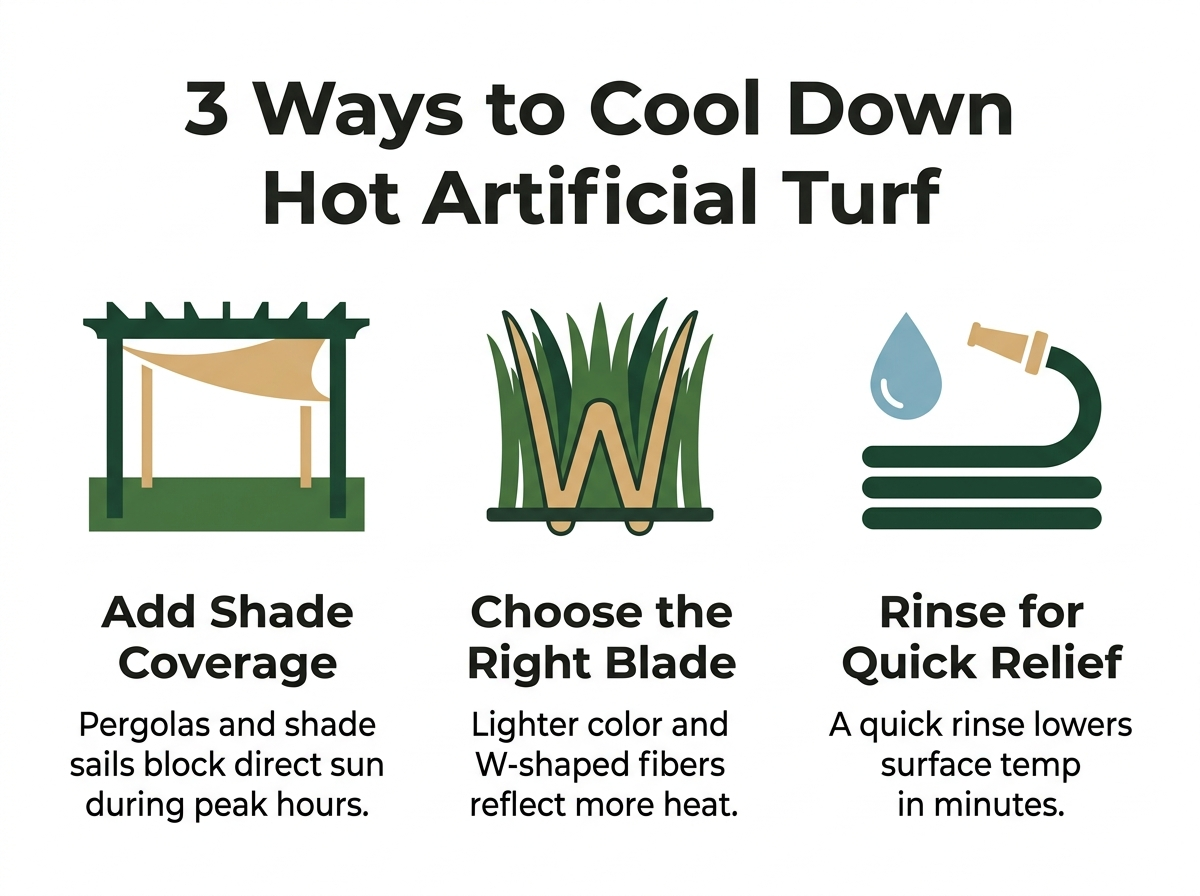
Beyond infill replacement, shade coverage, blade shape, and water all help. A pergola or shade sail over the turf area blocks direct sun during peak hours and lowers surface temperature substantially compared to an unshaded section of the same yard.
Blade shape matters too. A lighter-colored product with a W-shaped or diamond-shaped fiber reflects more heat than a flat blade, which lays heat-absorbing fiber flat against hot infill below. For immediate relief, rinsing the turf with a hose drops surface temperature quickly, not permanent, but effective in minutes before kids or pets need the yard.
Quick Questions
How hot does artificial turf get in Florida summers?
Artificial turf in Florida can reach 150 to 180°F in direct summer sun with crumb rubber infill, far hotter than the surrounding air. Turf with cork or silica sand in shaded areas runs 20 to 40 degrees cooler in equivalent conditions.
What can I do to cool down turf that's already installed?
Replace crumb rubber infill with cork or silica sand, add a pergola or shade sail, and rinse the surface with water for temporary relief. If the turf itself is a dark, heat-absorbing color, replacement may be the better long-term fix.
Is there a turf product that stays cool in Florida's heat?
Lighter-colored, UV-stabilized turf with a W-shaped blade and cork or silica sand infill performs noticeably better than darker products with crumb rubber. Ask your installer to specify blade shape, color, and infill before choosing a product.
"The hot turf problem is almost always an infill problem. We don't use crumb rubber on any installation in South Florida. Cork or silica sand on every project, and we've never had a heat complaint," says Matt Patella of The Time Is Now Design & Build, 11 years in South Florida.
Ready to Fix Your Turf's Heat Problem?
An infill assessment is the right starting point before deciding whether to replace material or start over. The Time Is Now Design & Build uses cork infill standard on every installation across Davie, Weston, Southwest Ranches, Fort Lauderdale, Parkland, and the rest of Broward and southern Palm Beach County, backed by 11 years of South Florida experience.
Read
the complete South Florida artificial turf installation guide for full product and installation guidance, or reach out for a
free turf infill assessment on your current yard.